Designing a Flexible Remote Support Access
Helping facilitators structure creative collaboration through visual clustering at the revergence stage.
Overview
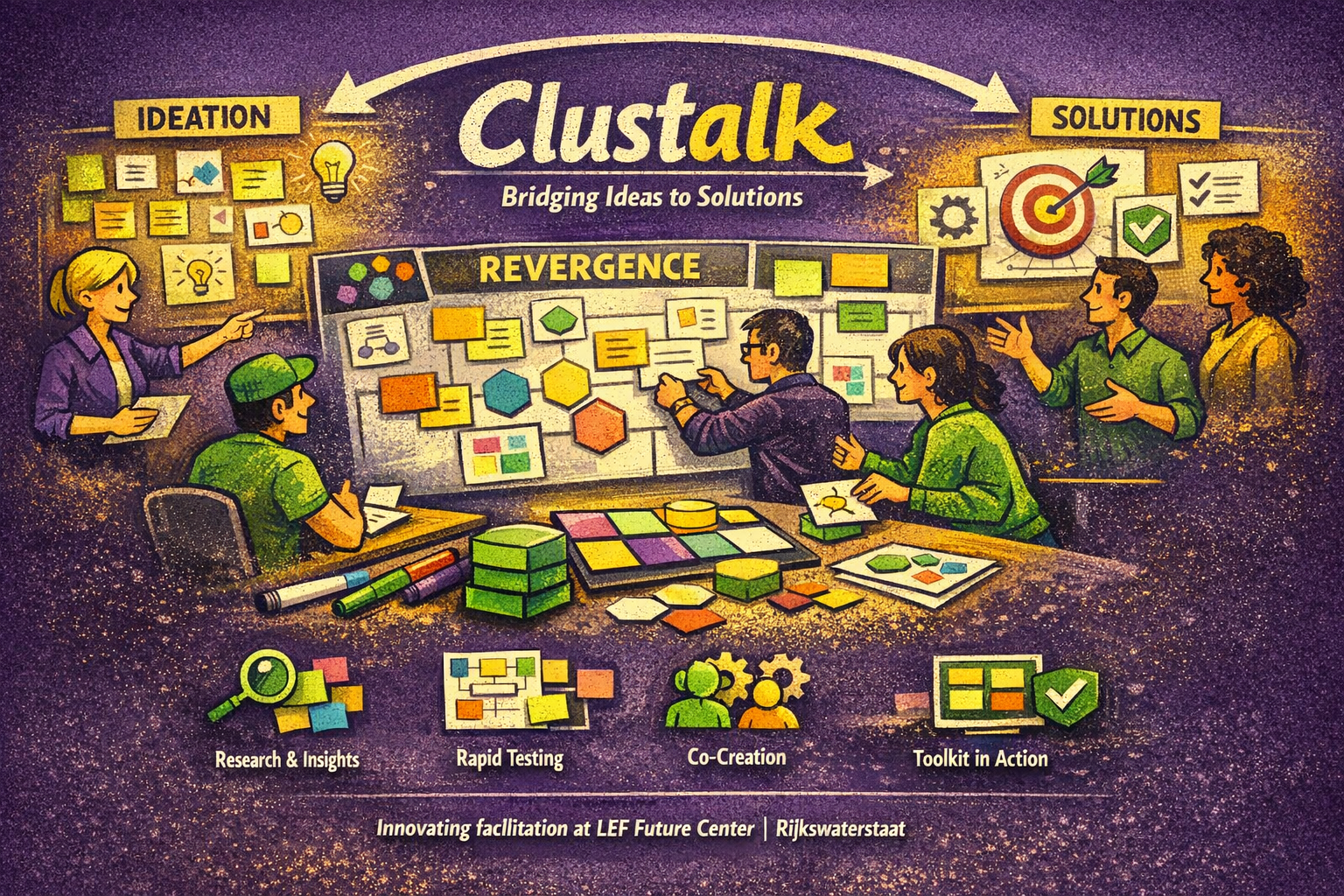
At LEF Future Center, an innovation hub within the Dutch Ministry of Infrastructure and Water Management (Rijkswaterstaat), I led the design and research behind Clustalk, a creative facilitation toolkit developed to enhance collaboration during workshops for complex governmental challenges.
The toolkit improves how participants visually cluster ideas, supporting facilitators through a clear and engaging revergence process. It is a stage often overlooked between divergence and convergence in creative methodologies.
My role combined user research, facilitation, and project management, using contextmapping, co-creation, and rapid prototyping to develop and evaluate the concept in real-world sessions.
LEF Future Center hosts creative facilitation sessions designed to help stakeholders explore complex problems, co-create solutions, and reach alignment on strategic topics. Facilitators often apply the “creative diamond” model, diverging to generate ideas, then converging toward solutions.
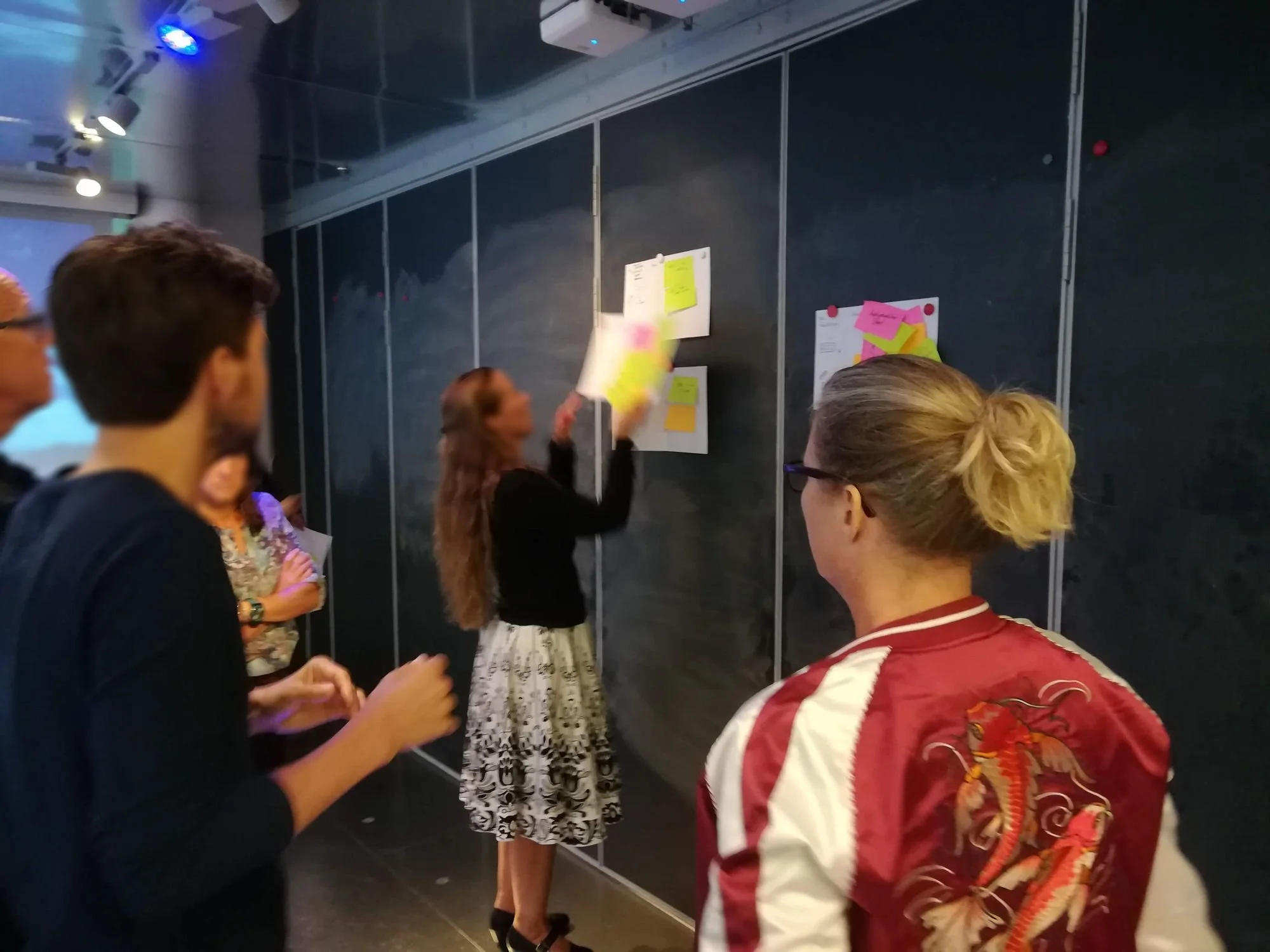
However, during field observations, I identified a recurring gap between these two phases. Facilitators and participants tended to move directly from idea generation to selection, leaving clustering, a natural sense-making phase, informal, inconsistent, or completely omitted. This caused disorganized outcomes, reduced visibility of creative breadth, and limited the potential for clearer, more structured insights.
Recognizing this missed opportunity, the project aimed to make clustering a visible, guided, and repeatable part of LEF’s facilitation process.
Context
Problem
Although clustering is critical to transforming scattered ideas into structured insights, LEF facilitators lacked a consistent method or tool to support it.
Several core issues emerged through the research:
Unstructured clustering: Grouping ideas relied on personal facilitation style rather than shared methodology.
Missed creative potential: Without a formal revergence stage, many ideas remained underexplored or lost in the transition to convergence.
Cognitive overload: Participants often struggled to visually organize ideas under time pressure.
The challenge was to design a physical facilitation toolkit that could make clustering more intuitive and help facilitators guide groups through the often-overlooked revergence phase.
Process
1. Empathize — Understanding facilitators and participants
I conducted contextmapping and interviews with LEF facilitators, combining generative tools and field observations to understand how creative sessions were typically run.
Found that clustering naturally occurred after brainstorming but lacked structure or visibility.
Mapped facilitator workflows to see when and how “organizing ideas” was informally handled.
Insight: Facilitators knew clustering mattered but didn’t recognize it as a distinct and valuable phase: the “revergence” moment between divergence and convergence.
2. Define — Framing the opportunity
Using insights from interviews and statements, I reframed the challenge around supporting the reverging phase.
Through desk research and pattern analysis, I defined the design opportunity:
“How might we help facilitators make clustering a deliberate, visual, and collaborative phase during creative sessions?”
This led to design principles emphasizing structure, clarity, and collective ownership.
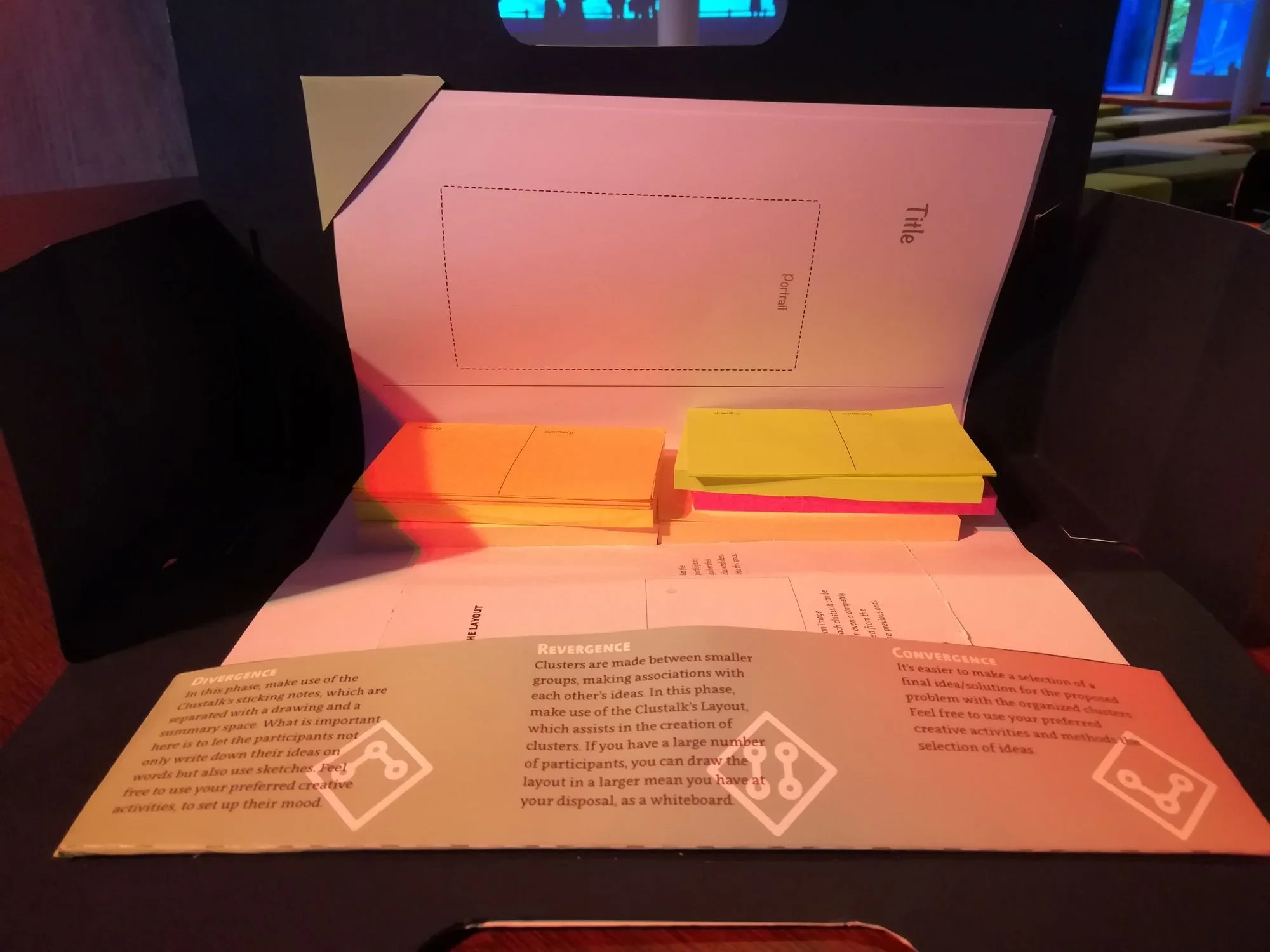
3. Ideate — Prototyping rapid concepts
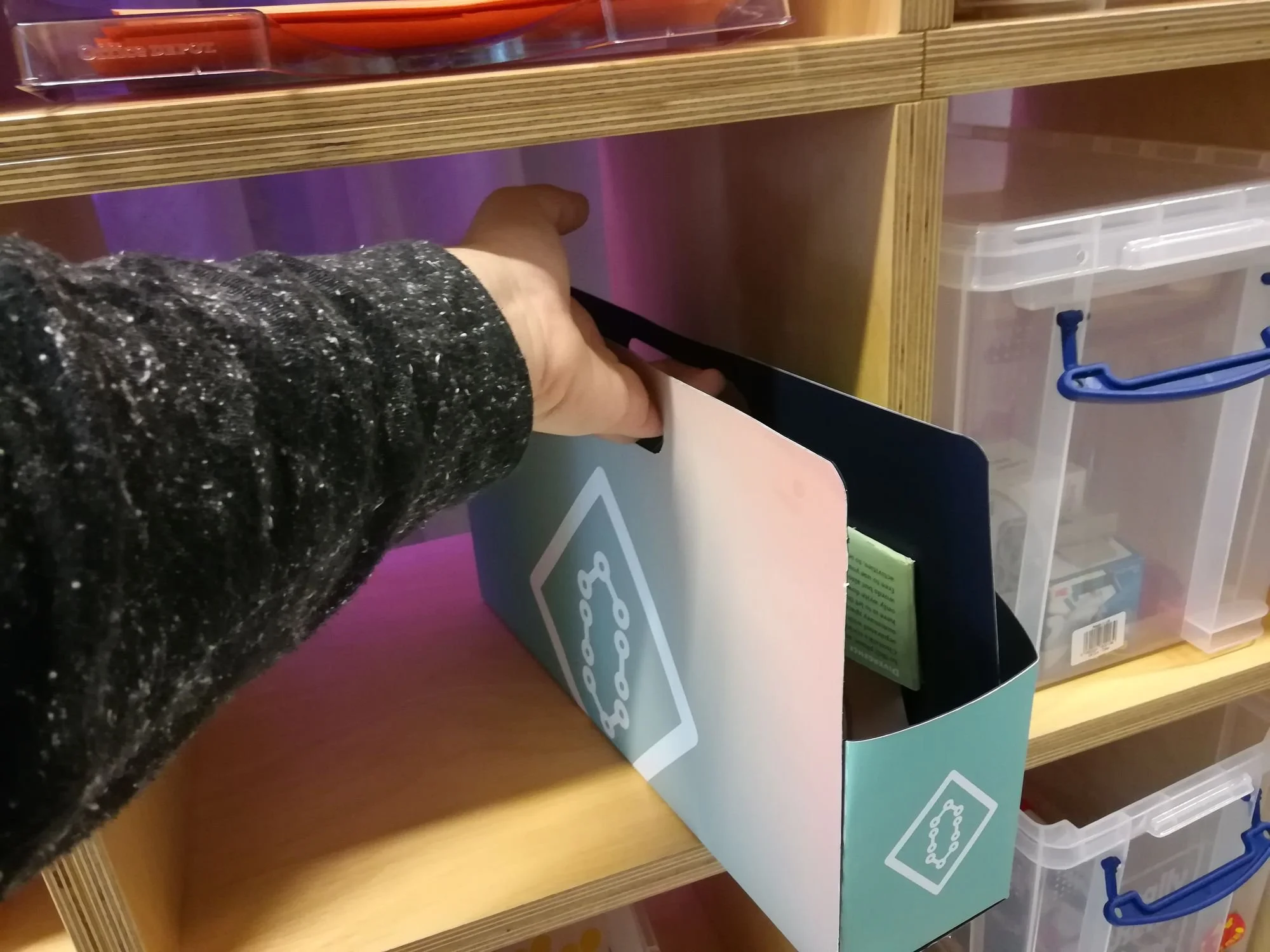
To generate and validate ideas quickly, I built three low-fidelity prototypes exploring different physical layouts and interaction mechanics for idea clustering.
Each version encouraged the use of visual elements (e.g.: structured sticky notes divided into space for both a small sketch and a textual summary).
Facilitators and participants tried these formats in short test sessions.
Finding: When clustering tools visibly structured clusters, participants organized ideas more naturally and collaboratively.
4. Evaluate — Testing in real sessions
The final prototype, Clustalk, was tested through two workshops involving 14 facilitators at LEF Future Center.
The tests focused on real government-related topics, allowing us to evaluate how the toolkit performed in authentic facilitation contexts.
The toolkit’s visual layout and modular parts helped facilitators:
Guide participants through structured clustering.
Maintain clarity when revisiting ideas.
Stimulate visual engagement and team reflection.
At the end of the evaluation, facilitators recommended further development, envisioning a digital version for broader accessibility.
Outcomes
Clustalk became an integrated tool in LEF’s facilitation space, complementing their existing suite of creative methods. It formalized the revergence phase as a distinct part of LEF’s process and substantially improved session flow and participant engagement.
Key improvements achieved:
Structured clustering built into the facilitation process.
More balanced participation during idea organization.
Tangible, clear deliverables capturing the full creative potential.
Increased facilitator awareness of the “revergence” phase and its value.
The project also generated a repeatable framework for evaluating creative facilitation tools, which influenced future innovations inside LEF.